
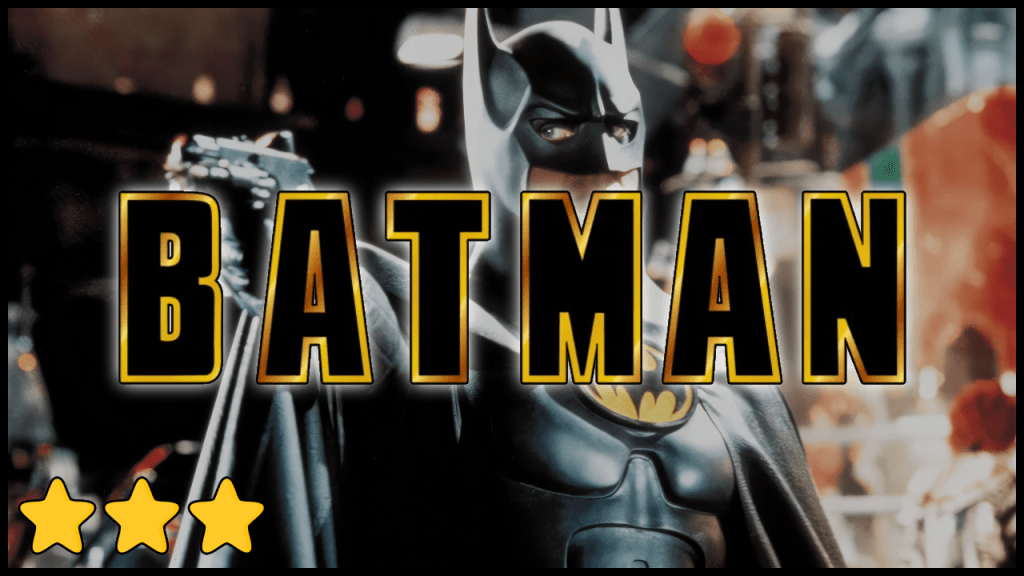
⭐ ⭐ ⭐ ☆ ☆
Directed by: Tim Burton
Starring: Michael Keaton, Jack Nicholson, Kim Basinger
When Batman hit theaters in 1989, it didn’t just release a superhero movie — it changed the cultural temperature around comic book adaptations. Darker than what came before it, stylized in a way that felt almost gothic fairytale, and anchored by a controversial casting choice in Michael Keaton, Tim Burton’s Batman redefined what the genre could look like.
And yet, watching it today is a fascinating mix of admiration and mild detachment.
Let’s get this out of the way first: Michael Keaton is my favorite Batman. There’s something about his performance that just works for me. He doesn’t play Bruce Wayne as a traditional suave billionaire. He’s awkward. Withdrawn. Slightly unhinged. There’s a quiet intensity in his eyes that suggests this man is absolutely not normal — and that’s the point. His Batman isn’t bulky or overly theatrical. He’s controlled. Focused. Mysterious. Even when the script doesn’t give him much dialogue, Keaton sells the character through presence alone.
Opposite him, Jack Nicholson’s Joker is pure spectacle. He chews the scenery with a grin, leaning into the theatricality of the role. It’s less psychologically grounded and more comic-book flamboyant villainy. There are moments where it’s entertaining, even iconic, but there are also stretches where the performance overwhelms the tone Burton is trying to establish. The movie sometimes feels like it belongs more to Nicholson than to Batman himself.
Burton’s Gotham City is the real star here. Production designer Anton Furst’s vision of Gotham — all towering gothic architecture, smoke, shadows, and art deco menace — still holds up as one of the most distinct comic book cities ever put on screen. The film doesn’t aim for realism; it aims for atmosphere. And it nails that. Danny Elfman’s score, swelling and heroic yet slightly melancholic, only strengthens that mood. It’s one of the most memorable superhero themes ever composed.
But where the film falters for me is in its storytelling. The narrative feels thin. The emotional arcs never fully deepen. Bruce’s internal struggle is hinted at more than explored. The romance with Vicki Vale (Kim Basinger) exists more as a genre requirement than a compelling dynamic. Even the central conflict between Batman and Joker feels more like a series of set pieces than a fully developed rivalry.
The pacing can feel uneven, particularly in the second half. The final confrontation is memorable visually, but it lacks the emotional punch you’d hope for in such an iconic matchup. There’s spectacle, but not much weight behind it.
As a fan, I admire what Batman represents. It paved the way for everything that followed — from darker superhero films to the eventual evolution of the genre into something massive. And I’ll always have a soft spot for Keaton in the cape and cowl. He feels like Batman to me in a way that’s hard to shake.
But beyond the atmosphere, the music, and the legacy, the film itself feels more influential than emotionally gripping. It’s stylish. It’s bold. It’s important. But it doesn’t fully invest you in its story the way the best superhero films eventually would.
That doesn’t make it bad. It just makes it slightly underwhelming compared to the pedestal it’s often placed on.
Still, seeing Keaton step into the shadows for the first time remains something special.
Final Rating: ⭐ ⭐ ⭐ ☆ ☆


Leave a Reply